


The structural problem of modern office work is uniformly felt and rarely addressed at the root: forty hours per week of sustained sitting produces predictable changes in hip flexor length, thoracic spine mobility, posterior chain strength, and breath mechanics. Yoga is not the only practice that addresses these changes, but it is one of the few that can be done in office clothing, in a small space, in fifteen minutes a day, with no equipment beyond a small mat. Used consistently, the practice produces measurable changes in the kinds of pain and stiffness that desk work generates. Used inconsistently or incorrectly, it produces moderate benefits that may not justify the time investment.
This piece sets out three practical yoga sequences for desk workers — a morning routine, a midday reset, and an evening wind-down — each designed to take ten to fifteen minutes and to address specific patterns of office-work-related stiffness. The aim is to be specific and practical rather than aspirational.
What desk work actually does to the body
Sustained sitting produces several measurable physical changes. The hip flexors (particularly the iliopsoas group) shorten in adaptation to the seated angle. The gluteal muscles weaken from disuse. The thoracic spine tends toward kyphosis as the upper back rounds forward. The cervical spine compensates with forward head carriage. The diaphragm operates with reduced excursion because the rib cage’s freedom of movement is restricted. The wrists, fingers and forearms develop chronic tension from sustained typing positions.
None of these changes is permanent, and most respond to relatively modest counter-interventions. The 2018 systematic review by Oakman and colleagues in BMC Musculoskeletal Disorders identified consistent benefits from short, structured movement breaks across multiple workplace studies, with effect sizes comparable to ergonomic equipment changes.
The yoga-specific literature is more variable but generally positive. The 2022 review by Ross and colleagues in Journal of Occupational Health Psychology identified moderate effects of workplace yoga programmes on neck and back pain, with effect sizes comparable to physical therapy interventions in many measures.
The morning routine: ten minutes to start the day
The morning routine targets the postural patterns that develop overnight (lower-back stiffness, hip tightness) and prepares the body for the day’s demands. The sequence below takes approximately ten minutes when held at the indicated breaths.
1. Cat-cow (Marjaryasana-Bitilasana)
From hands and knees, alternate between rounding the spine (cat) and arching gently (cow), coordinating with breath. Round on exhale, arch on inhale. Five to eight rounds. The pose mobilises the entire spine in flexion-extension and warms the surrounding musculature.
2. Down dog (Adho Mukha Svanasana)
From hands and knees, tuck toes and lift hips. Maintain a slight bend in the knees if hamstrings are tight; the priority is the length of the spine, not straight legs. Hold for five breaths. The pose stretches the entire posterior chain, decompresses the spine and gently extends the wrists in the opposite direction from typing.
3. Low lunge (Anjaneyasana)
Step the right foot forward into a low lunge, with the left knee resting on the floor. Hold the position with the chest lifted for five breaths. Repeat on the other side. The pose addresses hip flexor shortening directly, opening the front of the hip in a way that sustained sitting cannot.
4. Standing forward fold (Uttanasana)
From standing, fold forward with a slight bend in the knees. Allow the head to hang heavy. Hold for five breaths. The pose stretches the hamstrings and lower back gently while inverting the head briefly.
5. Mountain pose with breath (Tadasana)
Stand tall with feet hip-width apart, arms relaxed at sides. Take five deep breaths, focusing on lifting through the crown and lengthening the spine. The pose reinforces upright posture and provides a moment of stillness before the day begins.
6. Standing back bend (modified Anuvittasana)
Place hands on the lower back, gently arch backwards while keeping the chin slightly tucked. Hold for three breaths. The pose counters the day’s coming forward-rounded postures preemptively.
The midday reset: five minutes at the desk
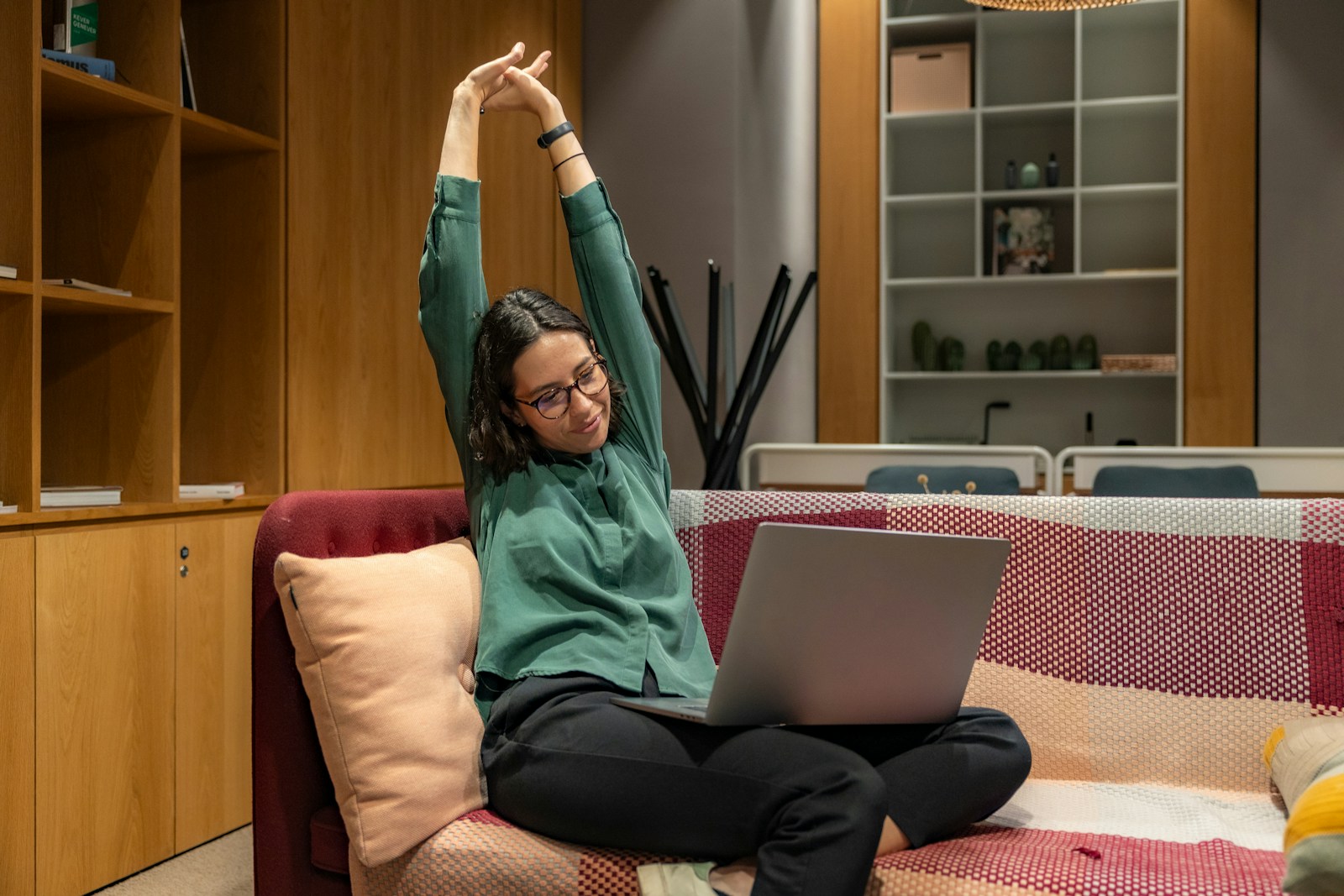
The midday reset is designed for very short breaks at the desk and addresses the postural strains that develop through the morning’s work. None of these poses require leaving your chair, though some can be done standing if space permits.
1. Seated cat-cow
Sitting at the front of your chair with feet flat, place hands on knees. Round and arch the spine through five to eight breaths. The pose mobilises the spine without requiring floor space.
2. Seated spinal twist
From the same seated position, twist gently to the right, holding the back of the chair with the left hand. Hold for five breaths. Repeat on the other side. The pose mobilises the thoracic spine, which sustained typing tends to lock in flexion.
3. Wrist stretches
Extend one arm forward at shoulder height, palm up. With the other hand, gently pull fingers toward the floor, then toward the ceiling. Five breaths each direction. Repeat on other side. Counter-stretches the typing position directly.
4. Neck circles and side stretches
Slow controlled circles of the head, three each direction. Then drop right ear toward right shoulder, hold five breaths; repeat left. Addresses the cervical strain of looking at screens.
5. Eagle arms (Garudasana arms)
Cross right arm under left, wrap forearms together until palms touch. Lift elbows to shoulder height. Hold for five breaths. Repeat with left arm under. The pose stretches the upper back and shoulders in a direction directly opposite to typing posture.

The evening wind-down: fifteen minutes to release the day
The evening sequence targets the cumulative tension of the day and supports parasympathetic activation for sleep. The poses are held longer than in the morning sequence, with emphasis on relaxation rather than activation.
1. Legs up the wall (Viparita Karani)
Sit close to a wall, then swing legs up the wall as you lie back. Adjust until your sit bones are close to the wall and your back is supported on the floor. Hold for five minutes. The pose is a gentle inversion that supports lymphatic drainage and produces parasympathetic activation. It is one of the most consistently calming yoga poses available and requires no flexibility.
2. Reclining bound angle (Supta Baddha Konasana)
Lie on your back, soles of feet together, knees fall outward. Use cushions under each knee for support if hips are tight. Hold for three to five minutes. The pose opens the inner thighs and hips while keeping the spine neutral.
3. Supine spinal twist (Supta Matsyendrasana)
Lying on your back, draw right knee toward chest, then guide it across to the left side, keeping right shoulder on the floor. Hold for five to ten breaths. Repeat on other side. The pose releases low back and hip tension that has accumulated throughout the day.
4. Child’s pose (Balasana)
From hands and knees, sink hips back toward heels and stretch arms forward (or rest them alongside the body, palms up). Hold for two to three minutes. The pose is restorative, providing a moment of quiet inward attention.
5. Final relaxation (Savasana)
Lie on your back, arms slightly away from sides, palms up. Allow the body to rest fully on the floor. Hold for at least three minutes; longer if time allows. The pose provides the integration period that allows the nervous system to consolidate the practice’s effects.
Practical considerations
Several practical points help establish a sustainable home practice.
Consistency matters more than length. A daily ten-minute practice produces substantially better results than a weekly hour-long session, both because the cumulative volume is similar and because the daily practice maintains continuous nervous-system effects rather than relying on weekly resets.
Practice does not need to be perfect. The goal is movement and breath, not ideal alignment. Most desk workers improve substantially through approximate practice without ever achieving « ideal » forms.
Combine with a useful workplace setup. Yoga supplements ergonomic improvements rather than replacing them. A properly adjusted chair, monitor at eye level, keyboard at appropriate height, and regular standing intervals collectively produce more benefit than any single practice alone.
Listen to pain signals. Yoga should not produce sharp or pinching pain. Stretching sensations and mild discomfort are appropriate; sharp pain indicates the practice is being done incorrectly or contraindicated for your specific condition.
Consider working with a qualified teacher initially. Six to twelve sessions with a qualified yoga teacher produces substantially better technique than self-taught practice from videos, even if the long-term practice is done at home. Look for teachers with substantial training (300-hour or higher certification, ideally with an additional therapeutic specialisation if you have specific conditions).
What to expect over time
Most desk workers who maintain a daily practice for three months report noticeable improvements in the most common office-related symptoms: lower back stiffness, neck and shoulder tension, hip tightness, and general energy levels. The improvements typically become noticeable within two to three weeks and continue to develop over the first six months.
The practice plateaus, in the sense that gains slow after about a year of consistent practice. The benefits become maintenance rather than continuous improvement. This is consistent with most physical practice; the gains of the first year are typically larger than the cumulative gains of years three through ten. The daily practice still matters at maintenance, however, since stopping the practice tends to produce regression toward the previous state within several months.
When to seek further support
Yoga practice is well-suited as a complement to professional care for office-work-related issues. It is not generally a substitute for professional intervention when problems are significant. Persistent pain that does not respond to two months of consistent practice warrants assessment by a physiotherapist, sports medicine doctor or other qualified clinician. Specific conditions including disc problems, nerve impingement and structural spinal issues require professional guidance about which yoga poses are appropriate and which should be avoided.
Targeted sequences for specific complaints
For practitioners with specific office-work-related complaints, several targeted sequences address the most common patterns. These can substitute for the general sequences above on days when a specific issue dominates.
The lower-back stiffness sequence
For workers whose primary complaint is lower-back stiffness from sustained sitting, the following sequence focuses specifically on the lumbar spine and surrounding musculature. Knees-to-chest pose (Apanasana) lying on the back, held for ten breaths, opens the lumbar region. The supine spinal twist (described in the evening sequence above) follows, held longer than usual at five to eight breaths per side. The pigeon pose (Eka Pada Rajakapotasana) opens the hip rotators that often refer pain to the lower back; held for two to three minutes per side with appropriate cushion support. Bridge pose (Setu Bandha Sarvangasana) strengthens the gluteal muscles that disuse has weakened. The total sequence runs about fifteen minutes and addresses lower-back stiffness more directly than the general sequences.
The neck and shoulder sequence
For workers whose primary complaint is upper-back, neck and shoulder tension, the targeted sequence emphasises thoracic mobility and shoulder release. Thread-the-needle pose (Parsva Balasana), held for ten breaths per side, mobilises the thoracic spine in rotation. Cow face arms (Gomukhasana arms) addresses the rotator cuff and external rotation that typing and mouse use particularly tightens. Eagle arms (Garudasana arms) provides counterstretching to typing posture. The puppy pose (Uttana Shishosana) opens the chest and shoulders simultaneously. A simple shoulder shrug-and-release (lift shoulders to ears, hold three seconds, drop completely) at the end helps release residual tension. About ten minutes total.
The headache prevention sequence
For workers whose desk work produces tension headaches, several specific poses address the muscular contributors. The neck tractions (gentle self-applied traction with hands cupped behind the head) help decompress the cervical spine. Cat-cow with deliberate chin tucks adds active cervical mobility. Eagle arms reduces the upper trapezius tension that often produces headache. Forward fold with relaxed neck and head allows passive cervical traction through gravity. Fish pose (Matsyasana, with cushion support if needed) opens the front of the neck and chest, counteracting the forward-head posture of screen work. Five to seven minutes total, ideally done before a headache develops rather than after.
The integration with workplace ergonomics
Yoga practice produces better results when integrated with appropriate workplace ergonomics. The 2019 study by Hokwerda and colleagues at the University of Twente found that workers who combined a regular yoga practice with proper ergonomic equipment reported substantially fewer musculoskeletal complaints than workers who used either intervention alone. The combined effect was approximately 65 percent better than ergonomic equipment alone, and approximately 45 percent better than yoga alone.
The ergonomic essentials include a chair with adjustable height and lumbar support, a monitor positioned at eye level (typically requiring a riser or stand), a keyboard at appropriate height with the elbows at approximately 90 degrees, a mouse positioned to avoid lateral arm extension, and adequate lighting that does not require leaning forward to see the screen. Several specific products have research-supported designs, including the Herman Miller Aeron (or comparable mid-tier adjustable chairs), monitor arms from Ergotron and similar manufacturers, and split or alternative keyboards from Kinesis, Microsoft and others for workers with significant typing volumes.
For workers in standard office cubicles or shared workspaces, advocacy for ergonomic adjustments is often the most consequential single intervention. Most contemporary occupational health frameworks support employee requests for ergonomic adjustments, and many insurers will fund ergonomic equipment for workers with documented musculoskeletal complaints.
Misconceptions about workplace yoga
Several common misconceptions about workplace yoga deserve correction. The first is that yoga must be done in a yoga studio environment to be effective. It does not. Home practice produces equivalent or better results than studio practice for most desk workers, partly because home practice is more easily integrated into daily routines and partly because the consistency advantage outweighs any technique advantages of studio classes.
The second misconception is that flexibility is the goal of practice. It is not. Most desk-work-related problems are not fundamentally about flexibility but about strength, mobility through specific ranges of motion, and habitual postural patterns. A practitioner who develops dramatic flexibility but does not strengthen the postural muscles or change daily postural habits typically does not see substantial improvement in office-related symptoms.
The third misconception is that yoga is sufficient as a complete physical practice. It is generally not, particularly for desk workers with sedentary lifestyles. The 2020 review by Cramer and colleagues found that yoga combined with cardiovascular exercise produced substantially better health outcomes than yoga alone for sedentary workers. The recommended practice typically includes 150 minutes per week of moderate aerobic activity (walking, cycling, swimming) alongside daily yoga practice.
The fourth is that all yoga styles are equivalent for desk workers. They are not. The slow, alignment-focused styles (Iyengar, Hatha, restorative yoga) typically produce better results for office-related complaints than faster more athletic styles (vinyasa flow, power yoga, Bikram). The athletic styles can be appropriate as supplementary practice but do not address the specific compensatory patterns that desk work produces.
Specific apps and online resources
For practitioners wanting structured guidance for home practice, several apps and online resources provide reasonable instruction at modest cost. The Down Dog app offers customisable sequences with reasonable progression options. The Glo platform (formerly Yogaglo) provides extensive instructor-led classes from established teachers including Stephanie Snyder and Jason Crandell. The Yoga With Adriene channel on YouTube has produced more than 600 free classes with substantial coverage of desk-work-specific concerns.
For more focused therapeutic applications, the work of Tias Little (whose Prajna Yoga school in Santa Fe has produced detailed online content) and the Iyengar tradition’s online resources provide deeper instruction in alignment-focused practice. The Yoga Therapy training programmes accredited by the International Association of Yoga Therapists produce qualified practitioners for specific therapeutic applications.
For workers wanting to combine yoga with other contemplative practice, the Insight Timer app provides extensive meditation content alongside yoga material. The Sounds True publisher has produced substantial audio courses combining yoga and meditation in single integrated programmes. None of these resources substitute for some early in-person instruction with a qualified teacher, but they provide good support for continued home practice.
Further reading
The Wikipedia entry on yoga as exercise provides broader context. The US National Institutes of Health National Center for Complementary and Integrative Health publishes evidence reviews of yoga for various conditions. The Harvard University Health Publishing programme has produced several evidence-based summaries of yoga for back pain, neck pain and stress reduction relevant to desk workers. Our archive on yoga and meditation is at yoga & méditation, with broader energy practice material at pratiques énergétiques, and a separate thread on workplace health covering ergonomics and movement breaks in more depth.
This article is for informational purposes only and is not medical advice; consult a qualified healthcare practitioner before beginning any new physical practice if you have musculoskeletal, cardiovascular or other significant medical conditions.